Friday, March 3, 2017

San Juan Bi-color Worm

Beaded San Juan Bi-color Worm


 After fishing the Bi-color San Juan worm in the Big Horn River a few years ago with great success on the wild brown trout I brought it home and started tying the bi-color worm. I added a bead to some ties to get the pattern down quicker in fast water. Both with and without the bead have been catching fish ever since.
 Here’s the way I tie my pattern and have no reason to ever change it except for adding different colors on occasion.

The Bi-Color Beaded San Juan
Hook; #10 or #12 3x long curved.  J. Stockard JS 720H
Thread; Red
Bead; brass, gold or copper
Back body; Red Ultra Chenille standard
Front body; Wine Ultra Chenille standard
Mouth and anus; Burnt ends of chenille

 1. Place bead on hook and leave behind eye of hook

 2. Thread base hook shank from behind bead to bend of hook. 

 3. Measure red Chenille so the front end will be a good distance behind eye of hook leaving room for front of body.
Tie down at bend and bring thread about ¼ distance behind eye of hook.

 4. I add a layer of glue along the top of the threaded shank. This keeps the chenille from rolling over.

5. Lay the chenille on the shank, tie down as shown and cut thread.

 6. Push bead up against front of chenille. (You might want to add a bead of glue where you place the bead.)
Start a new thread base behind eye to bead and back behind eye. Keep a gap between thread and hook eye.

  7. Secure wine chenille behind eye with chenille, extending over bead, with thread wraps and bring thread back behind eye as shown.

 8. Fold chenille forward, over itself, and tie down behind eye of hook. Trim ends of chenille to desired length.


 9. Take a flame and quickly burn the tips of the chenille. This will hold the chenille from unraveling and coming apart.

 Here are a couple other Bi-color San Juan worms I tie. 

 Where else to keep those worms but in a designated worm can.

~doubletaper


Saturday, February 25, 2017

Petroleum in the 50's

Petroleum in the 50’s
2/22/17

 My grandpa was wise when it came to hunting and fishing. He would tell me where’s there’s one rabbit there is another. Back then I didn’t understand why but he was right most of the times that I recall. I always figured this applied to trout also in big waters. 

 After fishing in central Pa. the past couple of days I did pretty well catching trout beneath the surface with nymphs. I was hoping for a BWO hatch and rising trout but it never came about. Wednesday, being it was suppose to be in the high 50’s, I was hoping for a hatch of either BWO or stoneflies with rising trout. I gathered up my gear and warm clothes and headed over to Petroleum Center area on Oil Creek.
 When I got there I seen the water was moving at a good clip but was wadable and at a good level as far as I was concerned. It was clear but the overcast sky kept the deeper holes opaque. With the winter snow runoff I figured the water would be quite cold so I wore my neoprene chest waders for warmth as well as knowing I would most likely get into some deeper water if I wanted to fish towards the far banks.
 I must have spent a couple of hour’s nymph fishing the section of water I chose at first. I covered the area that I could reach, pretty thoroughly and never got a strike. I didn’t even feel anything that even felt like it could have been a strike. I used different nymphs, San Juan‘s, and even tried a bugger now and then. I used an indicator at times and sometimes not. I added more weight to get my imitations down but it didn’t matter I couldn’t get a fish to bite. I knew they were in there but I just didn’t have the right stuff or they weren’t around.
 The second section I tried I came up with the same results. No strikes, no fish and a couple more lost nymphs due to underwater snags. I wasn’t discouraged in the least though. The air temperature turned out into the high 50’s and I was enjoying the quietness and a good cigar now and then. I’d get out of the cold water to give my feet and legs a beak from the chill but other than that I was fine. Sooner or later I had to catch a fish?

 The last section I was to try had been a good spot where trout held earlier in the year. It wasn’t a big wide area that they were holding in back during the low water days but I figured they might just still be hanging out there like a gang guarding their turf. With the higher water they may be spread out a bit more but I had a feeling they still might be hanging around. The problem was wading across the stream far enough to cast towards the far bank.
 I slowly and cautiously waded my way out through the water. Each step was thought out and I felt for slippery, or loose, rocks before resting my weight on my forward foot before taking another step. The water crept up my legs the closer I got to the middle of the creek and soon I started to feel the coldness of the water on my thighs through my waders. The current wasn’t making the going any easier. I found a safe place, with good footing, and decided to make a stand. I would have no problem reaching the far bank with my 9’ G2 Scott rod if necessary. 

  Though I wasn’t sure a trout will chase a Woolly Bugger in the cold water conditions in February but I figured if I swung one in the current I might get at least one to strike. I use a bugger as an attractor to find out where the fish hold especially for rainbow waters. There’s usually one bow that will hit a bugger if there is a gang of them around. Once I find the gang, and they quit hitting the bugger, then I’ll resort to nymphs.

 The bugger fell about 3 feet short of the far bank. As the bugger sank the rest of the line arced on the surface water and started to swing the bugger beneath. I kept my eye on the fly line for any sudden drop in the tip and held the fly line between my thumb and fingers in my left hand so I could feel any sudden tug. I saw the fly line dip and felt the light pull of the fly line as the arc narrowed on the surface. I quickly set the hook with a swift backhand of the fly rod keeping the fly line tight between my fingers. The line shot up from the water surface and tightened from the hooked fish. The trout pulled and tugged as it swam with the current near the far bank. As the rod shaft flexed deeper the trout swam and tugged in an arc down creek. Because of the swift current I kept the rod tip near the surface not wanting to bring the trout up into the swift surface water. I kept a tight grip on the cork as the fish played in the current and tired itself out. It decided to swim away towards the far bank again and because of the pressure of the trout and force of the current I let it have some line yet kept the reel drag tight enough to add that extra resistance of the wayward trout. Once I felt the trout didn’t have the fight in him, as when we started, I started to reel in bringing him towards me. Usually I will hand line him in but in water to my thighs and the strong current this would leave a lot of floating line in the water. There would be a good chance these erratic trout could get caught in the line when trying to net it or playing him out near me. Close enough, down stream, I took my net out and drew him closer moving the rod upstream. A last little splashing about, after exhausting any of his exuberant energy, I was able to cradle him in my net.

 I continued swinging the bugger and managed a couple more trout before the action ceased.

  Being that black stoneflies and Blue Wing Olives are the first hatches here in PA. I decided to nymph fish a lil black stonefly. For some reason I found a Picket Pin with a stonefly dropper works well together. With a little extra split shot on the leader I was ready to go deep.
 With the indicator attached I didn’t feel my offerings were getting down deep enough. I tried big looping mends but I felt the indicator was moving faster on the surface and not keeping the nymphs near the bottom long enough. I took off the indicator and it took big continuous mends and proper rod positions to get a likeable drift beneath the swift current. Once I managed this, the strikes started to come again. Fighting the fat rainbows in the current flow to net wasn’t always successful. The ones I hooked into that took the wet fly, instead of the nymph, were more energetic with skyward acrobatic twists and turns even in the cold water conditions. 

  The rainbows were nice and fat and gave me some good battles. Things finally died down and the cold water upon my lower body was starting to be extremely uncomfortable. I tried wading down creek to cover a different section but the water was too deep and I didn’t feel comfortable wading the slippery bottom with the swift current. I cautiously turned and waded back towards the shoreline.

 Not wanting to quit just yet I decided to pitch and swing a Woolly Bugger while wading down creek, along the bank, in safer water. Occasionally I would nymph fish in certain areas but kept coming up empty. The sun never came out and there never was a hatch to speak of. I hooked the bugger in the hook keeper and headed to the truck. It was about 3 when I got to the truck. I was satisfied with my catch and decided to head home.
 The day didn’t turn out like I wanted but I caught some fatty rainbows that gave me some good battles. I didn’t fall in and didn’t lose too many flies so it did turn out to be a pleasant outing. Maybe I can luck out and get into a hatch soon with some good dry fly action.

~doubletaper


Tuesday, February 21, 2017

Quiet Waters

Quiet Waters
2/20/17

Far from road noise
Away from the sounds of construction vehicles
Absent from garden and lawn tractors
Distant from passing locomotives

Beyond the crowds that
are enjoying the warm February weather
Absent from local fishermen
I come to the remoteness of the forest

The small creek flows with the sound of gentle riffles
Birds rustle about the dry forest foliage
A lone leaf can be heard tipping bare branches
as if falls from an aged oak

The smell of forest pines
The coolness of the forest breeze
The presence of laurel
The calmness that is felt

The lightness of the 3 weight fly rod
I roll cast into the mountain stream
My hand tied nymph drifts within the dark waters
searching

The line hesitates
and with a swift but gentle set
the line tightens
The rod flexes with activity

A wild trout tugs and darts
A small brown comes to hand
Its beauty is unmatched
Its release is unharmed

A smile forms between my cheeks
Excitement flows through my veins
Confidence is assured
I search for another

 As the sun lowers, evening draws near
Shadows form beneath the bank side laurel
The coolness of the temperature becomes more noticeable
Another wild trout struggles at the end of the line

 The day comes to a close
The journey home begins
A fire cured stogie awaits
Memories of this day comes to ponder

~doubletaper

Thursday, February 16, 2017

Olive Scud Tute

Dave’s Olive Scud

  Fishing a limestone stream in central PA. a friend of mine gave me a similar olive scud pattern that worked well. I took his scud and tied it on a pupa hook. Here is Dave’s Olive Scud.

Hook; #16-#20 pupa hook
Thread; 6/0 BWO thread
Rib; Fl. Chartreuse small wire
Shell Back; Olive scud back. ¼” wide cut in half
Body; Golden Olive rabbit dubbing with guard hairs
Head; BWO Thread

 1. Pupa Hook #18

 2. Thread hook shank to back of bend

 3. Secure Chartreuse wire to bend
I extend wire to top of bend to add a little more weight.

4. Secure olive scud back material at bend on top of wire and bring thread behind eye of hook leaving room for head.

 5. Add dubbing loosely to thread and wrap back to bend as shown

 6. Wind more loose dubbing to behind eye of hook as shown.

 7. Bring scud back over body, secure and trim.

 8. Wind wire in open wraps, over scud back, towards front of hook.

9. Break off wire and make thread head.
Trim off any unruly guard hairs and if necessary pick out dubbing to make legs.
I add a dab of head cement on thread head.

 On #20 pupa hooks I only dub body from back to front and I use olive dubbing with guard hairs.


Monday, January 23, 2017

January Rainbows

January Rainbows
1/22/17

 50+ degrees in January? No rain and calm outside? Seemed like a good day to take advantage and go trout fishing.

 From the parking lot I could see the water level was on the high side. It had good flow and the color was a tint on the green side which was about perfect color as far as I was concerned. Knowing the water would be deep along the banks I put on my chest waders. I put together my 2 piece SAS Scott fly rod and lined it with 5wt double taper line. I grabbed some stogies and headed to the water.

 With the chill of the water I didn’t think any trout would be too active wanting to exert much energy chasing a bugger so I decided to concentrate on nymph fishing. I knotted on a Beaded San Juan worm and dropped a brown Hares ear from the hook bend. I added weight to the leader and stepped into the water along the bank.
 I worked the seam along the fasted current just in front of me hoping the trout would be near the softer water and not out in the main flow. It was maybe my 5th drift along the seam that the indicator dropped momentarily and lifted up with my wrist to set the hook. I felt a little wiggle of a struggling fish on the other end of the line. He wiggled and tried swimming away but the 5wt rod was way to stiff to give the little guy any give.

 Back in the fall a few local Boy Scout Troops had a camp out along the North Fork Red Bank Creek in the park. They were gathered together to learn how to tie flies, learn about how to fly fish and the equipment used as well as stream entomology. I’m not sure what the number of kids and scout masters were but there was a large group of them with tents strung out along the park lawn. They were all there to receive their merit badge for fly fishing and had asked the local Trout Unlimited Chapter if we would help them achieve this. I was contacted by the head of the Iron Furnace Chapter and of course made time to volunteer. It was well organized with plenty of instructors. The young men were well behaved and respected us in a manner I haven’t seen a group of kids, this size, act in a very long time. To add to their benefit the TU chapter got the creek stocked with rainbows for the Boy Scout Troop. From what I heard was there wasn’t many fish to be had and the place they were able to buy the fish were in the size 6” to 8” range. I figured this little guy was one of these last fall stocked fish.
 After about an hour I looked down creek and the early morning sun broke through the cloud cover and was shining on the water down creek. I was hoping for a stonefly hatch. Seeing the sunshine I waded out and headed towards the sun.

 I spent an hour or so without any takes. The stonefly hatch never occurred. It might have been because of the high water level. Once the sun shown upon the water upstream I went back up creek.
 I fished San Juan worms in the faster water and nymphs as a dropper most of the time. I found with a little extra weight and eliminating the indicator got my nymphs down where the fish were and was more successful. I caught a few more small rainbows, that were pretty frisky, on an assortment of Hares Ears and little Black Stoneflies. I even caught one on a swinging picket pin. Later in the afternoon the sun disappeared and the air started to get colder. My lower extremities were really feeling the cold water by then and my feet were close to being numb. I felt I had enough fun and waded out of the chilled water towards my truck.
 While changing clothes I finished off the stogie I had been smoking and quenched my thirst.
 It turned out to be a fine January day to trout fish.

~doubletaper


Saturday, January 21, 2017

Slush, a Glass and Steel

Slush, a Glass and Steel
1/16/17

 I set the hook and the Wonderod flexed into the midsection. My cold wet hands tightened around the aged cork grip as the vintage rod held firm. When I felt the give and then a sharp tug of the rod tip I knew I had a fish and not another bottom snag. With a couple of head shakes he headed with the faster current down creek.

 The morning was brisk, about 25* when we got out of the truck. We saw a couple fishermen were already casting lines into the cold water of the long pool hoping for a bite. When we got to the creek we watched slush floating on the waves through the riffles that emptied into the pool. The pool current was slowed and with all the drifting slush it made not much open water to drop an offering. We crossed the creek in the riffles and I set up along the pool as Donny broke bank-side ice down from were I stood. It wasn’t long after I stopped moving I felt the chill of the water against my lower thighs through my waders. My feet were still warm from the walk but I was sure it wouldn’t take long for them to stabilize in the frigid water. I felt the crisp air of winter tighten the skin exposed beyond my beard. I began to knot on a tandem rig of sucker spawn to the tippet and my fingers were showing less dexterity caused by the winter chill. I attached an indicator and pulled out line to make my first cast. It looked bleak as to getting a good drift between the drifting slush.

  Time and again we casted out trying our best to get the indicator and offering down to the fish. Our lines weren’t freezing at least so that wasn’t an additional irritation to getting our lines out. I always looked up stream before my next cast, even before my drift wasn’t completed, looking for a better opportunity to drop the offering in a clear path between the slush. It wasn’t going as planned but it was quiet and I was fulfilling that fishing need that built up during the snowy weeks of freezing winter.

  After an hour the slush wasn’t getting much better so Donny decided we should head down stream for more promising conditions. Donny was fighting a snot nosed cold and wasn’t up to his usual self. Though he wasn’t feeling well he still came out. He lives near the steelhead tribs so he can fish anytime he likes but decided to hang out and fish for the day with me which I always enjoy his company and steelhead stream experience.
 Down creek we fished a couple of spots with him hooking into one fresh steelhead that he did get landed. Other than that we plugged along trying to find a pod of steelhead. Anytime Donny was ready to move I always have to cast a few more times just to make sure. On one occasion I was determined to catch a steelhead before leaving. I even commented to Donny “I’m going to catch one!”
 After offering different combinations I decided to try a different approach. I wasn’t sure how deep the water was but the surface current was moving at a good clip. Sometimes I feel the surface current is much stronger than the deeper undercurrent therefore the indicator may be moving too fast on the surface not letting my offering drift drag free in the undercurrent. Not knowing the deepness of the water I also feel my offering may not be getting down in such situations. I decided to take the indicator off and give it a go. I made the cast along a seam of the wavy water that dropped my sucker spawn down into a deeper hole. My fly line drifted just below the surface and, as it was moving with the current, I watched it for any unusual motion. After it passed by me the end of the fly line started to dip and disappear.  I lifted a hook set hoping it was a fish. Sure enough the rod arced and the flexibility of the fiberglass started to dance with the frisky fresh steelhead. It wasn’t long before getting it safely to the bank.


 After the catch we fished a little longer and Donny was now pretty congested and was ready to head out. He crossed the creek and was already on the far bank heading to the path. We actually been out for quite a few hours and I was kind of surprised he stayed out as long as he did. Of course before I crossed the creek and waded out I had to let fly a few more casts.

 The end of the fly line went under in a hurry as the drift was passing through the faster current. I heaved the 8wt rod with force wanting to get a good hook set in the current. The line instantly tightened and shot down creek with the rod tip pointing towards the aggressive steelhead. I called out towards the bank to let Donny know I had another. In the slower current the steelhead swirled beneath and headed back beneath the stronger current. Down creek he swung around frantically before heading towards the flexed glass rod. Before I landed the steelhead it made a couple of trying escapes but the glass rod had enough firmness that I didn’t have to let out any line from the spool. By the time I got the fish to the bank Donny was already close by to take a quick picture of my steelhead.
 With that we headed to the truck. It wasn’t one of the best days we had fishing together but heck; we caught a few even through the hampering conditions.

 After I dropped Donny off home there was still a lot of daylight left. I headed over to a well known section and was surprised no one was fishing the usually crowded hole. I must have fished at least an hour or so trying to get a strike. I tried using all sorts of combinations and even streamers but couldn’t encourage a take. After that I headed down creek to a couple known holes I knew usually hold fish.
 I was wading and drifting my offering along the deeper bank-side water. The water I was wading in started to get deeper so I waded further from the bank. There looked like a good deep section of slow current water, away from the bank, so I took some extra time to fish it before moving on.
 My cast was upstream a good bit and as I kept the rod tip high I watched the indicator come drifting about a couple of yards upstream from me. When it got almost across from me I gave a little mend up creek so my fly line would drift even with the indicator. Just passed me the indicator dropped and I knew it wasn’t the bottom. I took in slack line with my left hand and just as quick lifted the rod with my right. The fish instantly hurried off with line peeling off the soft drag. I held the rod high as the fresh steelhead energetically darted and swam about trying to release the hook. Once it calmed down I tightened the drag and slowly moved myself back into shallower water.
The chartreuse sparkle spawn was stuck fast in the top of her lip. 

 It wasn’t long after that the light started fading fast. I hooked the spawn into a crevice of the cork grip and headed up through the woods and to the truck. Back at the truck I peeled off the neoprene chest waders and changed into driving clothes. I ate a cold sub sandwich on my way to the interstate. 
 Just before getting on the interstate I took out an Aurora Barrel Aged stogie. The toasty brown looking outer wrapper shown some veins but was well constructed and the cigar itself had a firm feel to it. The initial light up produced an abundance of smoke which gradually filtered through the slightly opened drivers window. The initial draw was a toast/charcoal flavor similar to a darkened toasted bun right from an outside charcoal grille. After a few puffs the flavor smoothed out and was quite enjoyable though getting a little bolder the more I smoked. I noticed a leathery taste upon my lips after a while as I continued on, listening to some rock and roll while I was cruising down the highway heading towards home.


~doubletaper


Friday, January 6, 2017

Orvis Sling Pack Review 2017

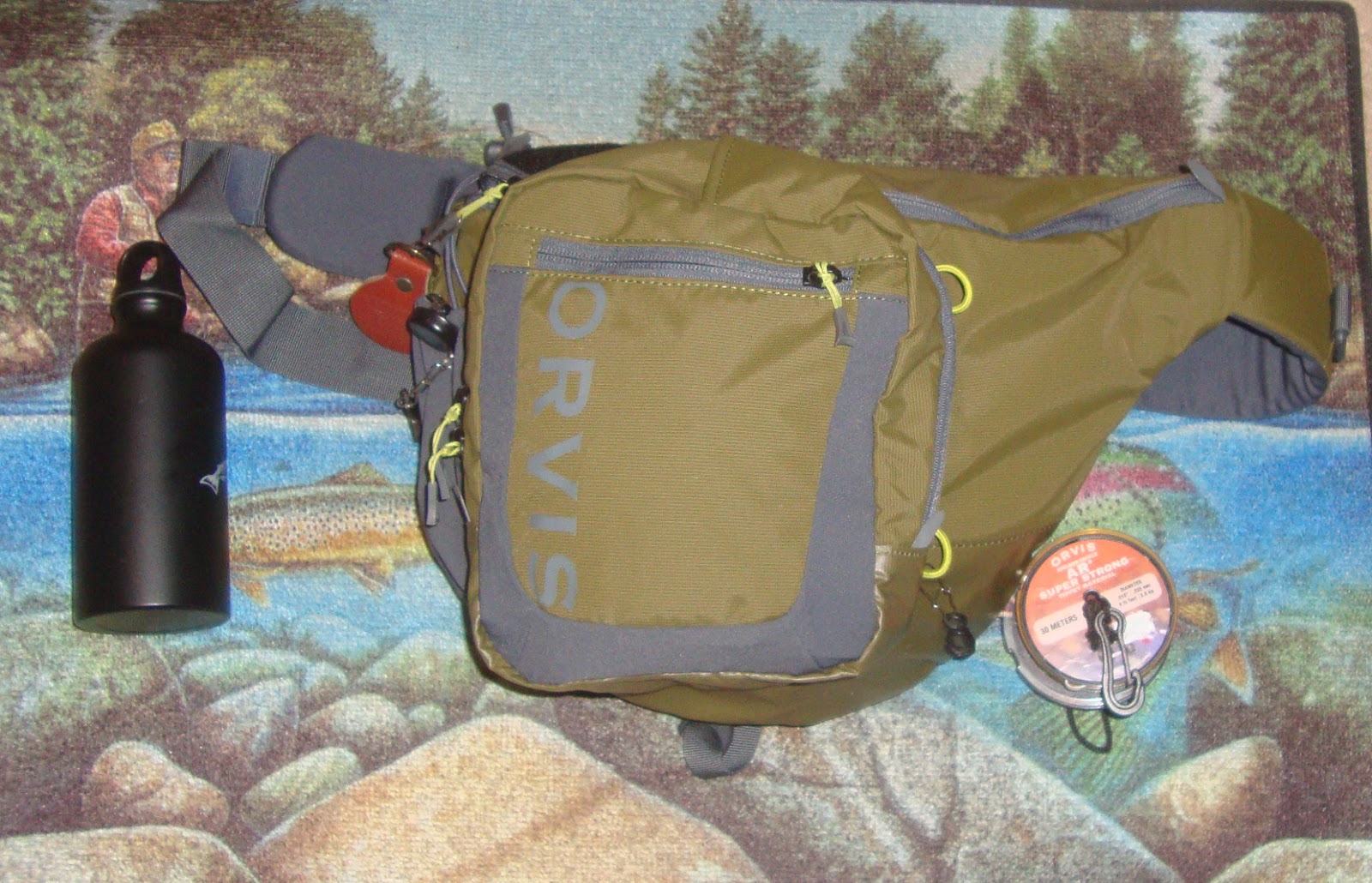
Orvis Safe Passage Sling Pack 2017  
   Bottle, Line straightener and tippet spool not included         
 With a couple Orvis gift cards I ordered a new Sling Pack from Orvis. It’s not that I really needed one because the other was worn out, I just thought it would be nice and more convenient. The whole purpose I got the original sling pack in the first place is for steelhead fishing and cold weather fishing to carry over a heavy coat. The original worked well but some improvements could make the original a lot better. Welcome Orvis Slink Pack new and improved.
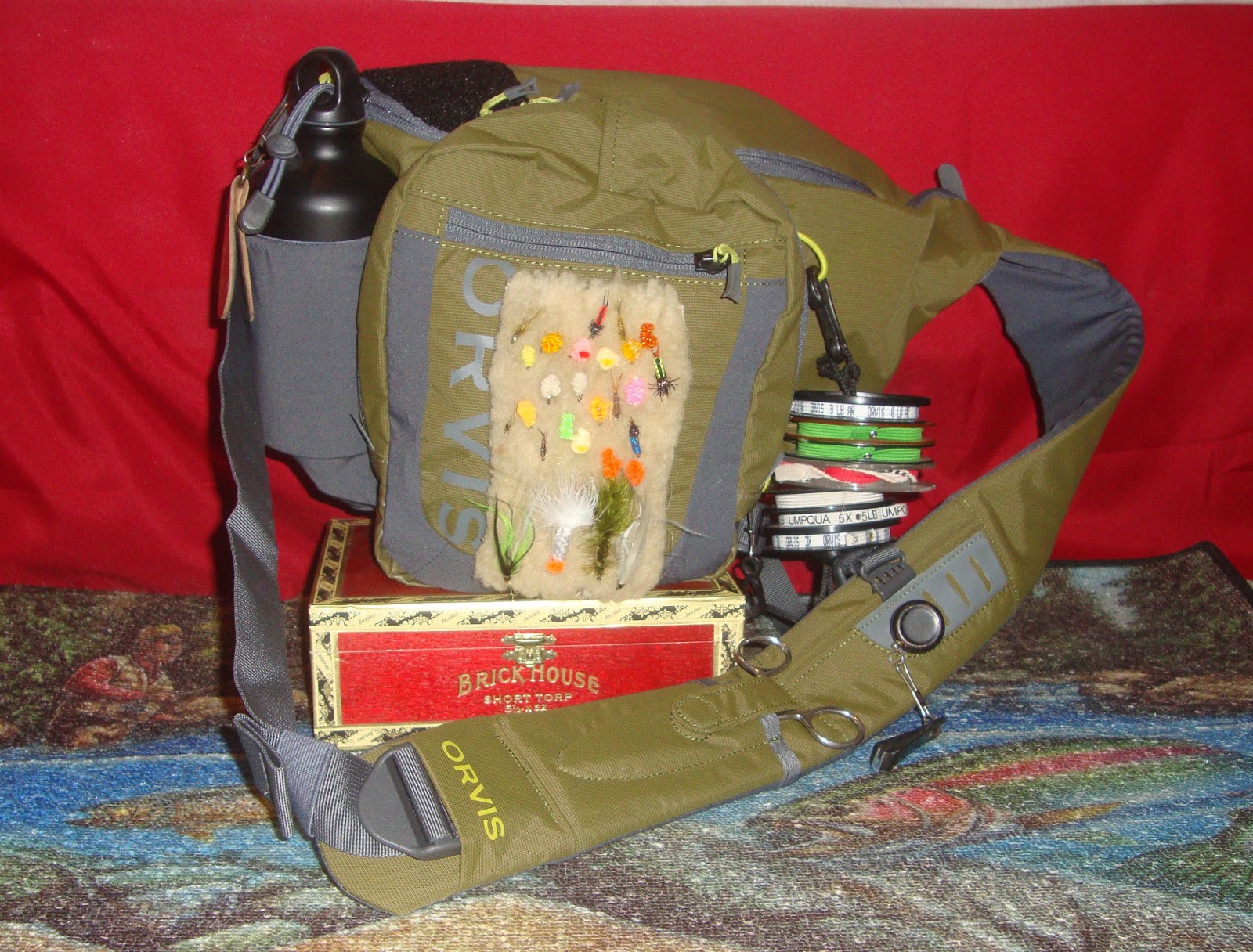
 The main big pouch as well as the smaller front pocket appears roomier. Both hold quite a few fly boxes. The big improvement is there are separate compartments inside each. This keeps other needs, such as extra leader, pack of indicators, flashlight, granola bars and such, easier to get to instead of all laying on top of each other in the bottom of the pack. The little zip pocket in front of the front pocket is great for the most used small items such as split shots and single indicators.

 With room to spare

 Next I like the position of where the hemostats are. They are on the shoulder strap that closes with magnets instead of on the pack itself like the older style where you had to turn the pack around to reach them. There’s a place that will hold an optional Tippet bar on the side of the front pocket but I found my tippet spool holder clamps on just as well.
 A new feature is a place to hold a water bottle with a bungee strap to keep it in place.


  I like to carry a wool fly patch for easy access to my useful flies and to dry the flies out. I added some Velcro strips to the front pocket and my fly patch. It stays put and is quick and easy to get to when needed.
 I also like that the bottom of the pack is coated for increased water resistance which is good for when I lay the pack on wet banks, snow or ice. There is a small fly patch on the top of the big pouch but I’m afraid an elbow will knock off any attached flies. It was a good thought though. There is also a place to put a zinger with your nippers just above the smaller front pocket. I rather keep it handier and there is a place on the shoulder strap that it can clip to.
 The bag is made of 400-denier. The shoulder strap is padded and adjustable to fit comfortable over a coat. The overall dimensions are 9” x 5” x 5 ¾” which is about 641 cu. in. It looks like the improvements, as well as the pack itself, will make things more convenient, handy and hopefully last for years!


~doubletaper