Sunday, February 21, 2010

Return to the Bass Pond

Then I Found the Hawgs
(August 2008)

I shake off the last few dribbles and look up into the fuzzy star lit night. I climb in the back of the van. At 1:35 am I set the clock for 6:05 am. ‘Wow, going to be a short night.’ With a couple of mixed drinks of Capt’n Morgan Tattoo in coke, a shot of Goldshlager and a few beers at Ray’s earlier, I’m sure I’d fall fast asleep and sleep soundly.
.
I awake to daylight. I remember shutting the alarm off some time earlier. I step out of the van and look towards the sky for signs of rain. A blanket of grayish fog is layered above the treetops hiding the sky above. After getting dressed and a cup of hot tea, I finish packing my gear into my ProGuide 3 in 1 chest vest. I’ll have to remember to thank Fishenfool again. The float tube fits in the backpack vest with pump, flippers and wading shoes attached. The chest pack fits enough fly gear, including reel, to make it easier packing into the remote places.
.
Jeff wasn’t able to come along this time so the 45-minute ‘walk in’ hopefully won’t seem that long. I have all day so time is of no concern.
 As I step onto the gated lane, from the parking area, a proud grouse sees me and high steps it into the woods. The first field I come to I catch 4 deer off guard. They finally perk their ears up as they hear my footsteps upon the lane and three of the deer leap their way into the forest. The last one stands tall next to the trail, alert. He must have noticed I’m carrying a rod tube and not a rifle. The deer casually turns and heads towards the others showing his white tail. Just beyond that I come across 2 piles of berry eating bear dung. A little further on two bunnies, eating the tops of the grass between the tire tracked trail, see me and hop into the nearby thick undergrowth. Closer to the pond I catch a glimpse of a turkey running through the tall ferns. At the bend he and another take flight. Pretty cool, I haven’t seen this much game in one day in the ANF since, well I just never have in one day.
.
 I lift off the pack and look across the pond, they call a swamp, from above the bank. The blanket of fog keeps the light to a minimum. The water is still and the area around the pond is lifeless. A few crows caw in the distance and the constant sound of tree frogs is heard in the background. The weathered gray tree trunks are no better off than they were last month strewn out across the middle and far side of the pond. There’s no chill in the air, on this August morn., so the T-shirt I’m wearing will be sufficient throughout the day. Looks like a great day to fish, alone, in the peace and quiet.
 After pumping up my ‘new’ u-tube I put together my steelhead converted to largemouth bass rod. This time I’m prepared. I loop on a 6’ 8lb. Bass tapered leader. To this I surgeon-knot about 16” of frog hair 6lb. tippet and connect a fast snap. I have a theory about fishing big waters, I use big flies and even the fast snaps don’t sink the big Humpy’s, Trudes and cork poppers I use. The fast snaps make for quick changes of flies and streamers without all the snipping and retying.
 By the time I get everything together and start to embark on my quiet venture the slightest of a breeze turns the smooth surface water into a calm riffle.
 Finning towards the left bank I toss my homemade cork popper out into the quiet riffled water. On my third cast I connect with an 8” blue gill. That’s nothing, I proceed to cast along the shoreline and start hooking up with 10” blue gill. What a surprise!
 I watch an osprey fly above and perch itself, on a jutting out, old limb from one of the weathered tree trunks within the pond. Continuing casting I hear a big splash and turn just in time to see the osprey rise from the splash. Talons empty, the osprey takes to another tree limb. Again casting the popper I catch another 10” ‘gill and upon reeling it in another splash from beyond. The osprey again ascends from the broken water empty. ‘That osprey sure knows where the fish are’, I think, hopefully I’ll be more successful than it was! After releasing the ‘gill I cast again and turn my head to look for the unsuccessful osprey. Just wanting to see it dive towards the water would be neat. A splash, this time close by, I quickly turn and see my popper waving upon a rippled spiral of water. That was no blue gill! I retrieve my small popper and tie on a bigger home made popper Jeff made. This time concentrating on my own fishing abilities and not the osprey’s.
 Slowly casting into a small deep inlet the cork popper drops with a small plop. Two gurgles of the retrieving popper attracts a mouthed swirl and my popper’s gone. Jerk and set I hook into a ‘nice one’. (It sure is relieving when you know you are using the correct set up.) The bass tussles beneath the surface but my rod and line are too much for him to handle. Fighting the fish it surfaces near the float tube. “Ya, that’s what I’m looking for” I say aloud. A nice 14” largemouth lies upon the apron. Not belly fat but a good heavy one otherwise. I let the fish go and look out into the clearing sky. “That’s how it’s done” I comment to the unseen osprey. I snicker to myself.
 I fin and drift for the next couple of hours or so casting to shoreline shallows and towards the submerged tree trunks. I pick up a couple more of the big blue gills on the popper. My brown woolly buggers and humpy’s didn’t do their magic this time out but I did manage to catch a couple blue gills on a lime Trude. I returned to where I put in to relieve myself and to give my shoulder a rest from the constant cast and retrieval of my flies. Upon shore I look out over the pond and I contemplate my next float.
.
The sun now peeks out from behind the big cumulus clouds floating in the dreamy light blue sky. The warm air has settled and the crickets now click in unison around the grassy areas. The water surface is a wisp of wrinkles from the slight breeze. An island stands alone on the right from the shoreline. There’s enough of a channel that an outcropping of small lily pads string out hugging the island towards the right bank. I notice activity in the back channel and around the lily pads. To get there I’ll have to cross the deeper part of the pond above the overflow dam. ‘Heck, might as well give it a try’.
 I float out and snap on a white woolly bugger, clamp on a split shot for the deeper water and begin casting. I pick up a blue gill and seem to be getting hits through the deep water so I fin and drift my way through a couple of times. I latch on to something that doesn’t feel like a blue gill or a bass. It gets off before I’m able to bring it to the surface. Hmm.
 Closer to the island the breeze starts to pick up. With precise judgment I backcast high and shoot the bugger down forward into the wind. It lands just before the string of lily pads. The bugger sinks and within a ½ of a strip my line tightens and I set the hook. The fish fights its way trying to release the hook. Not a bass but bigger than a blue gill for sure. The white lips and body of a crappie comes into view. I rest the 13” crappie on my stripping apron. What a surprise and what a fight! I release the fish and have to fin my way back within casting distance as the wind drifted me away. ‘Where there’s one there’s usually more.’ I thought.
 I cast again towards the lily pads, feel the bump, set the hook and this time a 14” wide crappie comes to the surface. Releasing the fish I once again cast and sure enough another 14” crappie surrenders to me.
 I think ‘I should have brought a stringer.’ I guess the crappies might puncture the underside of the tube or carrying them back would be awkward with the other gear I have to handle. They are some nice looking slabs that’s for sure.
 As much as I like the feeling of catching fish on buggers there’s nothing better than watching and catching them on the surface. I tie on the cork popper and wing it over into the lily pad edges. It’s harder to cast the light cork directly into the wind. After a few casts and no results I notice a dark thin branch sticking out of the water surface out from the shoreline. The wind has drifted me within casting distance so I didn’t disturb the water by finning my way. With the wind now blowing slightly across I pitch the popper and it falls just below the bent limb. I strip it as soon as it lands when a swirl, with a glance of a BIG white belly, catches my attention. Another quick strip and pop and a whirlpool sucks in my popper. I heave back and set the hook. The fish tugs and pulls hard away from me.
‘This is the one!’
 Knowing I have the right line and tight knots I give him as little leeway as possible. The heavy fish won’t come to surface but I guide him in the opposite direction he wants to escape to. With each direction change of the fish the rod tip flexes and follows in the new direction. Palming my reel with good tension the bent rod starts to straighten as the fish finally turns toward me. While reeling in the bass, it surfaces in front of me and dives deep again. With the butt of the rod in my gut I follow the fish with the tip of my rod not giving him much line. The big bass comes to the surface again and I thumb him onto the apron. ‘Oh ya!’ the 16” full belly hawg lies before me. I feel my fishing blood run through my veins with warm excitement, my heart pounding a mile a minute. ‘That’s what I’m talking about in this pond they call a swamp.’ I angle my hemostats into the fish’s mouth and unhook the penetrated barb from the roof of its mouth. I put the big bass into the water. With a whip of it’s tail I release the fish to fight another day. I fin around back up towards the exposed branch and cast for another. Ready, but nothing comes up for it.
 The wind again drifts me closer to the shore but down some. A lighter color limb is exposed from the depth. I strip line out and cast the popper within an imaginary point I set my eyes on within reaches of the stick. I hesitate a split second before stripping. A BIG BASS explodes out of the water. I swear I set the hook while the bass is in mid air. It smacks onto and then submerges under the water. It takes off across in front of me, subsurface, from left to right as I follow it with my fly rod tip high in the air. The dark object races just below the surface leaving a riffled wake behind. The bass then submerges hard, my rod tip bends, I must let line out. In an instant I feel the rod tip relax and than the bass explodes upwards fully out of the water. It’s gills flared and tail erratic. It belly flops back into the water as water sprays outward from the turbulence. My tight grip holds steady as it dives than once more it surfaces only exposing its head trying to spit out the popper. He disappears in the broken water. I watch my fly line start to slacken as he drives around me. My tube, rod and I follow in a semicircle with its force. Hurriedly taking in slack the lunker surfaces near my tube and upon seeing trouble it tries to dive deep once again. Pinching the fly line I wait to see if the fish has enough strength for another strong escape. The bent rod tension is now too much for the tired fish. At the surface to my left he rises. Reaching down in the water I thumb the bass by the side of its big mouth. The 16” fat hawg lies upon the apron with the sun reflecting off its oversized belly. I dislodge the hook pierced through its lower jaw. ‘Two in a row, back to back!’ I released the lunker. Taking a deep sigh of relief of my success I feel my shoulder start to come into question as I now take notice to the slight joint soreness.
 The wind picks up and casting the popper into or across the wind takes more effort and less accuracy. Looking at the far side of the lily pads I decide to fin around the island and come in from the backside channel. As I fin around, the tall grassed island breaks the wind. I tie on the white bugger, without extra weight, and cast off near the island bank. I pick off an 8” largemouth on the lee side. On the backside of the island I find it shallow and my guess is right that there is a slightly deeper channel of water closer to the mainland. I cast into the channel before proceeding. Without any takers I slowly push my way, with the tip of my fin, through the channel. Stopping every once in a while to cast my bugger close to the lily pads. I’m not sure if my movement or closeness gives me away but no fish takes my fly. I see and cast to still water in a slight arc within the lily pads. My white woolly bugger sinks and my fly line jerks. Setting the hook I force in another 13”-14” crappie. I return to the point of the island and cast a few times around the lily pads without success.
With my shoulder feeling sore I fin myself in the wind so it can drifts me back to my exiting point. I relax in my float tube with my fly rod out and my woolly bugger trolling behind me.
.
After packing my gear in my 3-1 chest vest I take a last swallow of water I brought along. I remember and look at the old pocket watch I had stuffed in one of the vest pockets, 2:00. Standing on the small breast of the earth work dam I look out over the pond. A sun warmed breeze blows across my body. The smell of wild flowers of some sort passes my nostrils and I inhale the clean fresh air. I watch the surface of the pond water riffle with the force of a gust of wind. The white puffy clouds above me almost glow in the blue sky reflecting the bright sun rays. The pond is quiet, peaceful, and appears lifeless. The old weathered tree trunks stand like guardians in the water as if protecting the hidden life below. Looking around one last time for any forgotten gear, I leave the pond area as I found it. With maybe a little more sun shine.
 A quarter of the way back I stop for a breather, along the lane, in the shadows of a maple and forest tree. I take out a zip lock bag and pull from it a Cohiba. I blow into the cellophane and slide out the cigar. I wet the natural outer-leaf and nip off a bit of the rolled end. Holding the flame near the end of the barrel I puff slowly till it lights.
.
Proceeding on, I think about the day’s outcome:
‘The wild life I seen this morning,
10” blue gills, 14” crappies
Largemouth ranging from 8” to 16” with two being real hawgs!
Fishing alone in the peaceful and quietness of the scenic pond
and a fine cigar!
It can’t get much better than this on an August day’
.
‘Well maybe’
.
(A few bottles of genuine Coors await me back in the van,
...in a cooler,
.........packed in ice.)

___________________~doubletaper

Monday, February 15, 2010

A Float Tube, a Bass Pond and The Fly Shtick!

Here is a two part story of my experience largemouth fishing back in the summer 2008. The second part will be published next week.
.
A Float Tube, A Bass Pond and The Fly Shtick!


With visions of catching my first Pa. largemouth with a fly rod, and good company, the 45-minute walk to the big pond, they call a swamp, didn’t seem too take that long. Besides that, the early morning hike was good conditioning for the ankle and leg joints for the next 4 hours or so of float tubing.
Standing along the breast of the small dam I started unpacking my gear while Jeff started inflating his float tube.
Looking down over the pond the weathered gray lifeless tree trunks are strewn out, individually, around the middle and far side of the pond. You just know there are big bass lurking deep along their sunken base. With the early morning stillness and knowing we are ‘back in’ made for an eerie feel. The water is calm and reflecting the cloud cover above. Rays of sun penetrate through the forest trees as it begins to rise over the hillside behind us. There’s geese honking in the distance wakening to their undisturbed domain. I notice ripples atop the water where fish are already scouring the shoreline shallows in search of food before the heat of the noon day sun.
.
After patching a small pinhole in my 15 some year old round float tube and refilling it with air, Jeff and I start down the grassy bank to begin our largemouth quest. Jeff fins his U-tube towards the strewn out crop of sawed off tree trunks as I head for the left shoreline.
 I tie on a #10 orange Humpy and cast to the first rise a distance away from the shoreline ripples. I lay a straight smooth soft cast and my Humpy drops on the water surface peaceful like. A little twitch and a quick response I set the hook and bring in a small bluegill. Finning a little closer to shore I drop the Humpy where the ripples were earlier without a response. Slowly I drift and fin my way up the shoreline casting into the shallows. Another soft landing and I watch a ripple in the water toward my fly. A small swirl and my Humpy disappears. I pull back and set the hook. This time it’s no bluegill. A small fight and I reel in a 9" largemouth. Not a big one but a largemouth no doubt. My first in Pa. with the fly shtick.
"Got one," I yell out to Jeff somewhere in the open water.
"Orange Humpy, ‘bout 9""
 I float out a distance from the shore and start tossing out a brown bead-head woolly bugger amongst the tree stubble around me. With each cast I concentrate on my backcast and then forward rod movement. The wrong timing and the heavy bugger may swat off my hat or worse yet latch into my float tube.
Watching my fly line sink with the weighted bugger my line starts to pull away. I already have my slack pulled in. I learned this from fishing down south last summer in a private lake.
.
Down in Virginia, My girlfriend’s brother-in-law asked if I wanted to fish Sunday morning in the small lake in the private development he lives in. I was hoping to fish the blue-ridge parkway but time wouldn’t allow it. Fishing’s, fishing so what the heck! We rowed out in his john-boat Sunday morn. There was a wind against us the whole morning so rowing into the wind wasn’t too fun. We’d anchor where the hot spots were suppose to be but not many largemouth cooperated. He lent me a spinning rod and I threw stick baits, rapala’s and spinner baits and other contraptions. He had his 3 or 4 rods in the back of the boat preloaded with his favorite lures. It wasn’t a contest by any means. Let’s face it, it’s his home waters and he’s a southern boy. They grow up warm water fishing. I, being a yank, just tried to keep things close. When the wind finally died down after a few hours I couldn’t resist piecing together my 5 wt. 4 Piece fly rod. A little under-power but like I said I had planned on fishing the blue-ridge for trout. We weren’t catching any big hawgs and I know how to play big fish anyhow. I tied on a beadhead brown woolly bugger and stripped out some line from my reel. He sat back and watched. I false casted until I got enough line out and shot the bugger in front of the rock shoreline. As my bugger sank I thought I had a strike but by the time I got the slack out and tried to set the hook, well no dice. After a few failures I figured the bass were taking the bugger on the way down, unlike most trout. I usually leave slack in the line until I get to the right depth and then let the bugger swing. Being in the lake I was waiting for it to drop and then I’d strip it in. I finally figured out to keeping the line tight at all times and being that the bass had big mouths and I was using only a size 10 bugger I must set the hook quick and hard. After catching on, I started to catch bass more often than we did earlier. It got to the point he just enjoyed watching me and rowed down the shoreline as I tossed the bugger to hungry bass. I didn’t catch any whoppers but I did show the southerner us northerners can catch bass too!!
.
As my bugger falls, my line pulls away, I heave my 9’6" rod up and back setting the hook into the fish’s jaw. The bass fights forward, surfaces, than dives deep towards the shoreline, still some distance away. The fly line runs through my tensioned fingers until the bass draws it to the reel. I let the reel drag take the fight along with the rod and occasionally palm the open spool. If I was wading I could put the butt in my gut for leverage but being in a round float tube I have to use both hands on the rod and stiff wrists. The bass’s force actually moves me and my tube towards him. Feeling the line tension in its mouth it turns to the left and proceeds to fight its way out to deeper water. Seeing the distance and tug of the fish will bring an exposed tree trunk between us. I struggle with my legs and fins towards the shallows to eliminate the trunk between us. I have no choice but to give the bass more line, as not to tension him too much that he will double back completely around the tree. With my fly line against the tree I reach my rod out towards the shoreline continuing to struggle around the tree.
It worked, the bass straight lined it enough I am able to get around the tree. Now it’s open water between the bass and I. I put the brakes on and let the rod bend putting pressure on the bass to turn. With a little struggle he turns and retreats towards me. Laying the bass on my stripping apron he ‘stretches’ out to about 15".
"BROWN BEADHEAD BUGGER" I yell out to Jeff, "NICE ONE!"
 Through the rest of the morning Jeff and I fin around casting in and around the tree trunks. I finally notice some riffles along a peninsula of flat grass jutting out into the water. I fin my way towards the peninsula and find I’m able to stand up in thick moss and branches on the bottom. I tie on a green cork popper and toss it over towards the shallows. I continue to toss the popper and slowly strip it in while twitching my rod tip to make it pop. Casting over to where I thought a deeper channel was that led to the shallow waters, I set the hook on an aggressive bluegill. Again I see riffles along the shore but this time I cast up and away from the fish in hopes he moves that way along the bank. I hesitate a second than slowly strip and twitch the popper towards me. A riffle starts to follow as I try to keep the same speed of the cork popper coming towards me. The bass inhales the cork and I set the hook. A little fight and I bring in another largemouth about 12" or so.
.
The morning ended with the sun high in the white clouded and blue sky. I thought at first it was the heat that softened my float tube but found out otherwise. The longer I tried to fish the softer the tube got and the deeper I sat.
"You look like an Amish straw hat in that round tube" Jeff blurted out.
 I turned around and back finned towards the shore where we put in. I could have finned my way to the closest shoreline but I found out last year fins in soft mud doesn’t work like snowshoes in snow!!
 The closer I got to shore the more the tube softened and the more water creeped over my bib chest waders under my armpits. Upon reaching dry land I tugged the tube up the hill and started pumping air in it to see where the leak was. Needless to say the more air I pumped into it, the small seam hole I found got bigger and bigger until it broke wide open. Whew, a close one. I couldn’t imagine being out in the middle in my neoprene chest waders with a sinking float tube!
.
The walk out took a little longer than the walk in with a few more rest stops. Jeff and I conversed about the usual things we do. Fishing and hunting and of course steelhead fishing. I guess I was so excited about catching my first PA. largemouth on a fly rod this morning I forgot to bring a cigar for the walk back!

____________________doubletaper

Sunday, February 7, 2010

My 50 Day

My 50 Day


 This past Saturday I was driving home from my granddaughter’s 5th birthday party. Heading east on rte. 62, towards Polk, I took my time rolling down the winding country road. Nearer to Polk I’d glance over the guardrail, time to time, through the drab gray and brown forest trees. They stood strong, anchored in the ground, below the pure white mounds of snow. Their tall skeletal bare branches intertwined among each other below the soft wintry blue sky. During the summer and fall months the creek I was now looking for would be hidden behind these trees full of their green and colorful leaves. But now, during January, the forest trees stood naked revealing squirrel and bird nests within their branches. Now the curious driver can see through these obstructions and get a glimpse of the flowing Sandy Creek waters winding its way through the forest. White snow now covers the uneven creek banks and ledges. Straggly fallen branches overreach the land boundary, in some places, and reach out over the water. The top halves of these gray branches show the thickness of snow fall from the past few days. Occasionally I see a clump of snow, as if frozen, upon an extruding boulder within the water flow. A group of undersized fir trees seem to huddle together in their own section of woods below the taller Oaks and Maples. Their boughs bent downward from the weight of the previous fallen snow that gathered on their olive colored branches.
 Watching the silent peaceful waters flowing into wide open 9’ fly-rod casting areas brought back memories. Especially of my 50 day outing a few years ago.
 Sandy Creek was like a “home waters” back when I lived north of Mercer. I got to know the waters fairly well. Though hatches weren’t plentiful, when it got into June and July, dry fly fishing I found was rewarding with patience.
 Early, during trout season, the creek gets hammered pretty hard by all types of fishermen. In some areas bank fishing is almost impassible so there are sections the land lovers can’t reach with their ‘throwing rods.’ the only way to fish this stream effectively is with hip waders or chest waders. You can fish it with just Hip boots but there are deep holes throughout and I found hip boots can’t keep me in the water continuously.
Early season its buggers or nymphs but I like to take this creek on in June and July for dry fly action. By then bass season opens and this gets the bass guys and boat fishermen off the stream. Also by then the green enthusiasts are out chasing their balls all day trying to get them into 18 holes. Good for them I say, less guys befuddling the trout stream waters.
.
Though my 50 day wasn’t my best catching day I ever had on Sandy, the experience will be embedded in my brain forever.
It went like this;
A few years ago my birthday weekend started on a Friday. I was down on Mill Creek, near Fisher, with my 4 weight slowly wading downstream picking off left over brook trout from the week before, which was the first week of the season. On this mostly shallow stony creek my thunder creek shiners and buggers were keeping me content with occasional hook ups. Around 1:30 pm I drove over to the Strattenville truck stop to meet up with my #2 son. He had driven up from Ashville, North Carolina, to fish with me on my birthday. Unknowing to him I knew the main reason he came up for this weekend. You see my non-fishing, non-camping, un-outdoorsy and unadventurous mom and siblings were planning to have a surprise birthday get-together for me. Being I fish, usually alone, on my birthday, their primary objective would be quite hard in finding me. Usually on my birthday weekend I’m in the Allegheny National Forest along some dirt roadside stream. From where I park I can be anywhere 2 miles upstream or down. Even with a GPS, that they probably couldn’t use anyhow, would have a slight chance just finding my van. All in all they would have about a 1% chance of finding me in the wilderness.
They were planning this for some time, I heard through the grape vine, and though they were told they might not find me, they were determined. I figured I’d make it easy for them and told Giddeon that on my birthday, Saturday, we would fish Sandy Creek. Giddeon was the go between, complete with cell phone.
Friday Giddeon and I fished Mill Creek and Millstone the rest of the afternoon before heading back to my house.
.
Saturday morn we left Clarion in darkness. Arriving at Sandy Creek the sun was just rising through the motionless bare trees. We parked along rte. 965 at the RR gate. Giddeon’s big black truck and my van stood out so my family should not have any problem finding them. I figured Giddeon would suggest going back to the vehicles at noon for lunch and my family would be there waiting to surprise me, right?
.
My son and I walked up the old RR grade, pass the wood mill, and hit the creek. Like most 2nd weekends of trout season the leftovers would be few and far between. I always looked at these stocked trout leftovers like they were the ones that got away or the smarter ones of the bunch. White woolly buggers and yellow woolly buggers are usually a good bet fishing these rainbow waters in the early season.
 The early morning went smoothly as we both caught a few rainbows clustered in pockets throughout the beginning stretch. Just near the rope swing I was casting across and letting the white bugger swing down stream into a deep hole. A guy standing on a handicap ramp told me my bugger was too high and that I should add weight to get the bugger down deeper. I thanked him and upon my next cast, without adding any weight, I mended the belly of the fly line upstream letting the bugger drop deeper before it began its swing. When the belly of the line started to be pulled by the current the rest of the extended line didn’t seem to follow. I lifted the rod sharply as my line started to race upstream on the hook set. I kept the rod high and watched the line follow the trout. As the line straightened out the trout turned and swam downstream at a good pace. I hurriedly took in line with my left hand. Practically in front of me the rainbow exploded out of the water and reentered. Miraculously the hook set was solid and I was able to bring the trout to the net.
 My next cast was a little nearer to the opposite bank. Mending line upstream again, the bugger sank deep in the slow pool before swinging. This time a rainbow grabbed the bugger at the end of the drift.
“You know what you’re doing” the guy commented.
 I nodded as I spat a wad of tobacco juice to the side. After Netting and releasing the nice fat rainbow, I looked upstream and motioned to Giddeon about the hot spot. I walked carefully along the bank and continued downstream.
 About 11:00am I was standing in the middle of a long straight stretch of water while Giddeon was upstream working the riffles with his rod in one hand and his cell phone in the other. I figured he was giving the surprise party directions to the vehicles along rte. 965. About 15 minutes later I was concentrating, tying on a yellow bodied woolly bugger, when a chorus of voices started singing ’Happy Birthday to You”.
 Looking up the bank, through the bare trees and brush, there were a group of people standing there singing!! There they sang the complete verse of ‘Happy Birthday’ and waving, complete with balloons and a ’50 years old’ sign.
 Boy, I was glad no one else was in the vicinity.
 I turned to look at Giddeon. He smiled and shrugged his shoulders as if to say “I don’t know how they found us”.
 Walking up to the family of singers there was my 70+ year old mother, my brother and his wife from Pittsburgh, my sister from Ohio and my oldest sister from Erie. My daughter stood there laughing with my grandson.
 We walked up to the RR grade and then down to the vehicles to address my birthday. I pulled out camping chairs and set a cooler down so they could set my birthday blueberry pie on it along with a waxed number 50 candle!
 Every fisherman that walked near us, my sister would yell to them that it was my 50’th birthday.
 I figure, for all the years I’ve fished my birthday weekend, this was the first time I ever celebrated it with my family. I was surprised no doubt, being that I am the black sheep of the family.
.
Oh well, I hope I didn’t mislead you with the title of this story.

__________________________Families are Forever ~doubletaper

Friday, February 5, 2010

Orvis Sling Pack Review


Orvis Safe Passage Sling Pack


I’m not one to give reviews, mostly because I don’t have access to use similar products to compare the good and bad. I do know when I buy and use something what I expect of such product. If the product surprises me in function or exceeds my original expectations I’m incline to let others know from my point of view, of course.
I was recently looking for something to use to carry my steelhead gear during the winter months. My regular fishing vest just wouldn’t do. Even though I buy it large to fit over a rain coat or insulated shirt, putting the vest over a heavy winter coat leaves me with confined movement.
For the last few years I’ve used a fanny pack. This was fine on most days during the early season but again when I had to wear a heavy coat the fanny pack was bulky under the bottom hem of the coat. Spinning it around and searching for something in it with or without gloves didn’t work very smoothly. Oh, and I don’t care for those chest packs either. I like it when nothing interferes with my casting or retrieving a fish on my fly rod.
Well along came this Orvis sling pack. I checked the reviews, usefulness and design of this sling. It seemed it was what I was looking for and so I ordered one to try it out. On two winter steelhead trips, this season, I decided it was what I was looking for. It worked great! Without getting into much detail, you can read about it on Orvis.com, here is why I like it.
First off it fits over a heavy winter coat and with the adjustable strap; I can size it to fit. It does not, in any way, hamper my casting, fishing or retrieving abilities. The two main compartments ‘sit’ in the sling behind my left hip. The smaller, removable, fly box pouch can stay attached to the front of the other two zippered main compartments or clamp on the bottom front of the sling where it’s near by but out of the way. This smaller pouch is great for the more common fly boxes I use. The larger main compartments holds a world of other fly boxes and gear as needed. The inside is separated by black netting. Though I thought it would have been nice to have more inner netted compartments for spool tippets or lead split shot. I found my own coat pockets were just as convenient and just as handy. The smaller convertible pouch does have an outside Velcro net pocket for a variety of my quick snaps and chap stick for greasen up the fly line and rod eyes during freezing weather.
The only thing I see that may be a problem is those who carry a net on their back. I carry a helping hand net glove that clips conveniently to the ‘D’ ring on my waders so it doesn’t bother me.
It would have been nice if there was somewhere on the front strap for a fly patch but I guess you can’t have everything. I just attached a wool patch to the front of the small pouch that works well and handy.
Well, that’s it. I give the sling pack a big A for design, accessibility, carrying capabilities and staying out of the way when it’s not needed, like when I’m fishen! Great stuff for around $49.00

You can see the 'sling pack'  and wool patch in this picture!

....tight lines ~doubletaper

Friday, January 29, 2010

White Wulff's and Bunny Leeches

White Wulff’s and Bunny Leeches
(Last page of 4 Men and 2 Forks)
July 2009


After a good breakfast of bacon and eggs we filled the cooler with lunchmeat, grub and beer and drove to another section of the Shenandoah River south of Luray, VA. We found a big parking lot to assemble our gear and with only a few vehicles in the parking lot, had high hopes for an enjoyable morning. Jeremy lined his 5/6 weight rod that he was more comfortable with. I lined my 5wt. Scott rod for Giddeon to use and Jeff and I stuck with our 6 weights we’ve been using the past couple of days.


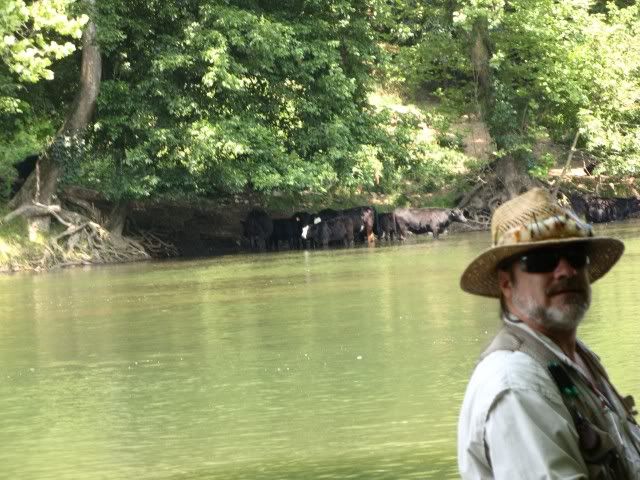
 Out in the new section we found deeper water between the submerged table rocks and ledges. A few cows grazed the forested posted area of the far gradual slanting bank. We spread out along the wide river and had a lot of room without interfering with each other. During the morning we all caught a few smallies but it wasn’t like the day before where we were constantly hooking up. A wind kicked up as we were wading down stream for lunch. Giddeon’s straw hat blew off so we had a comical cast and retrieve contest for the current flowing straw hat. Giddeon got a good hookup and brought it in without much of a fight. Jeff hooked into a small largemouth against the cement bridge abutment and I got a few pics. We sat around for lunch before heading back to the power dam.


.
 At the water edge, of the power dam, the sun was shining with big white clouds above our heads. Jeff and Giddeon headed upriver to fish below the dam on the far side of the river and Jeremy headed down river to the rock outcropping that he did so well on hellgrammites the day before. I waded out and stood between the island and near bank ready to fish my way down river.
 I have to admit that catching smallies and fallfish are fun with the buggers and poppers but it was getting old and I wanted something more challenging. Seeing blue damsels and a few fish rising for some top water, no-see’m bugs, I decided to try dry fly fishing. A few different Humpy‘s, Trudes, and #10 dries didn’t enthuse any fish. Taking a look into my fly box of big flies I tied on a white wulff pattern for a try.
 I saw a fish continue to rise in front of a small stargrass island some 30 feet away. False casting line out, I dropped the wulff in the general area and wham; the fish grabbed it in no time. The smallie fought tooth and nail through the heavy current and into the submerged stargrass and rocky bottom. I kept the Winston high as not to let the leader scrape against any rough rock ledges. The 12” smallie came to hand after a good hard fight. I noticed, across river, two fish were rising in the slower water out from the bank of the big wooded island that split the far side waters that flowed from the dam. The distance was too great from where I was standing and figured on trying for them later. I caught some glimpses of a few fish still rising around me so I played for them first. The white Wulff and rising smallies didn’t disappoint me. With each cast out, with the white Wulff, I was hooking up to smallies continuously. My dry fly fever was subsiding with each drop and hookup. I stood in one place, in the middle of the river and swear I hooked into every smallie I seen rising and then some. What an afternoon!
 Wading across river, I was now concentrating on the two rises out from the island. Both fish were upriver from me about 5 feet apart. The wind kicked up some so now I would be casting somewhat into the wind. I carefully waded upon the slab rocks and stargrass feeling beneath my boots before committing to stepping down. I was down river and to their left rear. I pulled out line and started my overhead cast. Casting into the wind I kept my back cast higher and shot my forward cast down lower before stopping my rod tip. This would make my wulff more wind resistant moving downward in the wind than more horizontal into the wind. My first cast was this side of my target, but I had plenty of distance. As soon as the Wulff pattern drifted down river from the unsuspecting riser, I quickly lifted my rod pulling line down with my line hand to generate line speed behind and above me. After feeling the rod load I dropped my forearm and pointed the rod right to the spot I wanted the fly to land. The white wulff penetrated through the oncoming wind and dropped nicely before the last rise. I’m not sure where the bass thought the Wulff was going but it came up quick and devoured the fly. A quick back hook set and the smallie took off down stream. Without letting line out, I kept the rod tip bent and followed him with the tip. Downstream I started to reel in the 3x tapered leader with him in tow.
 I tried for the next riser up river from the one I just caught but he didn’t want anything to do with the white Wulff. I was doing so well with it though that I wasn’t going to change flies just for one fish.
 I looked around for anymore risers and seeing none, I was satisfied and headed downstream to try my fly around the exposed rocks Jeremy was fishing around. I slowly caught up with Jeremy and he said he caught a few but not as many as the day before. Seeing Jeff down below where the river came together again, below the tree wooded island, I slowly fished my way towards him. I caught a few risers before I was within talking distance.
“White Wulffs are the ticket today” I said.
Jeff said he caught a few on different streamers.
“Where’s Giddeon” I asked.
“He’s up between the island and far bank” Jeff replied. “I gave him an olive bunny leech and he’s been hooking up pretty regularly.”
.
Later on when Giddeon came down river, he exclaimed he got into some 14”-15” or so smallies. He’d drift the olive bunny leech and jig it a few times and hook into one of the big smallies.
 Time passed and we were all getting a little tired and moving a little slower. The wind kicked up some and the skies darkened. About the time we figured out the falling sprinkles was going to turn into an all out downpour and not quit soon, we were as wet as our submerged wading socks and boots. We sloshed up to the van. The outside temperature was warm but being soaking wet wasn’t comfortable at all. We stood under the pines for a while and those of us that brought a change of clothes got into them. We stood around for a while talking among ourselves and having a beer or two, until the rain subsided. We headed back down to the river with raincoats.
The group headed downriver to the more rocky areas, whereas I stayed below the power house, casting my white Wulff randomly from out in the middle. I noticed the water was deepening gradually and with more tint from the earlier quick downpour. The jagged table rock and boulders would not be easy to negotiate without visual help. I stuck it out, out in the middle for another ½ hour. It was a ½ hour too late. The rain blew over the mountain, this time without warning. Bright heavy raindrops fell from the bright sky before the dark clouds could catch up from behind the tall obstructing mountains. I tried looking through the now opaque water, but the bottom was no longer visible. Slowly I took steps towards shore trying to feel the bottom and dangers through my heavy socks and felt wading boots. I started taking longer strides as the raindrops felt like pebbles falling from the sky. I was within 30 yards of shore, with the stronger current breaking against the back of my knees, when my left boot gave way off a slightly slanted table rock while my right foot was still not yet touchimg the river bed. My right boot didn’t grip in the wavy stargrass bottom and I was falling in an awkward unbalanced position. I knew the water wasn’t deep enough to cover my head but after I let go of the Winston rod, to feel for the bottom, I was submerged to my neck on all fours. My left hand kept me from sinking any further as my right knee scraped against some rough submerged rocks. My right hand quickly reached and grabbed the rod before I stood back up, bruised, soaked and bleeding.
“I had enough” I thought, “It would only be daylight for about another hour anyhow.”
 I sloshed myself to shore without any more misfortunes. On land I found my Winston didn’t suffer any damage though my hand and knee took the brunt of the fall. Under the shoreline trees Jeff showed up along the lane. I told him what had happen and I was giving up and heading towards the van. After passing the power plant, and heading up the stony road to the van, the sun came out in full view and brightness. It didn’t matter; I was done for the day. Getting drenched twice in one day was a fair warning of what else could go wrong.
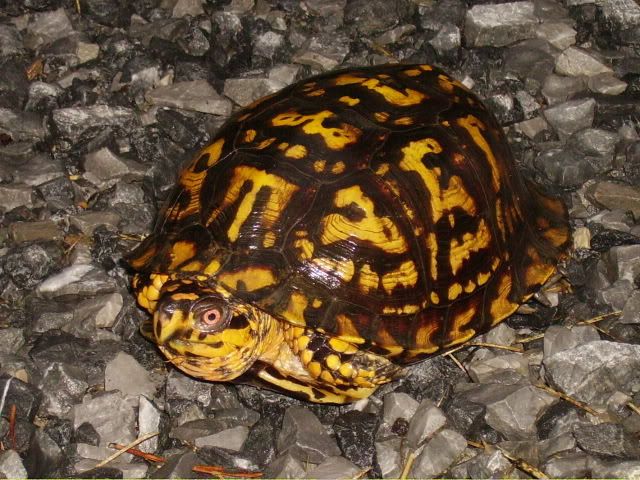
 I changed my clothes again, grabbed a beer and waited for the others. Jeff showed up soon after and the boys showed up just before dark. We were hungry for the deer chip steaks we were going to cook up when we got back to the cabin. We all had another good, though wet, day of fishing. We put away our gear and on the way out we came across a nice size box turtle in the middle of the gravel road.


Sunday morning, after a few more hours of fishing near by, we cleaned up camp and Jeff and I headed towards home. Jeremy and Giddeon headed toward the airport. It sure was fun spending time with my sons again and being on the water for 4 straight days of great fishing.

Thanks again, Jeremy, Giddeon and Jeff for a great entertaining time. Thanks to Mr. Cappola for the great lodge and Harry Murray’s fly shop for guiding, fishing instructions and useful patterns to make our time spent enjoyable.

          ____________________-~doubletaper

Monday, January 18, 2010

A Hunch Before Lunch


A Hunch Before Lunch
(May 2009)


The morning long but successful
my stomach aches for food
Through the forest I walk back
in a tired and somber mood
Driving up the back road
I know where I’ll take lunch
Parking aside the empty cabin
for some reason I have a hunch
I walk through wooded saplings
across an old RR grade
Peering over the steep dirt bank
there a rainbow lay
Basking in the bright noon day sun
as if he hadn’t a care
“Could this trout be caught?” I ponder
Though fatigued, I take the dare.
To the van and my 4wt. I decide
I tie on a delicate 6x
I feel I only have one cast
The situation so perplexed
Downstream I cross a riffled run
not wanting to make wave
I climb the bank, crawl the grass
there’s no cause to be brave
I wait for just a breeze
that would riffle the surface water
‘Till then I tie on a latex caddis
as the sun beats upon me hotter
The breeze finally comes at last
I slowly slip into the wetness
I pull out line almost motionless
as my shirt fills with sweatiness
I wait patiently, now exposed
another breeze spoils the water surface
I roll cast upstream from my quarry
accurately and with purpose
The white caddis drifts realistically
a short strip puts it within sight
His slight movement with open mouth
I draw the line quickly tight
He bolts away taking line
turns and swirls with anger
I let him fight on the light tippet
I know the constant danger
He rips upstream and takes a leap
my rod straightens with the rise
Splashing and slashing in the water
I have to compromise
He bolts upstream further on
I hold the bent rod high
Line slides through my guiding fingers
with the least pressure I apply
He crosses the stream and now turns down
I strip in line with haste
Now once in front of my line of sight
he turns and we’re face to face
We leer at each other eye to eye
neither foe nor friends
He swims downstream with bully force
the line re-tensions, the rod re-bends
He runs his gauntlet, fights his fight
but learns his match he met
My stomach growls with hunger
as dinner comes to the net

~doubletaper


Tuesday, January 5, 2010

Midges, The One that got Away

Midges, The One that got Away


 The past long weekend (New Years) brought cold weather in the teens and the temperatures stayed below freezing throughout the weekend. Snow fell every day and I was sure this iced up any open water or at least brought slush, so fishing was out of the question. My thoughts turned to tying up some midges before the TV remote battery went dead.
 The term ‘midge’ to fly fishermen has different meanings depending on who you talk with. Even in fly tying books it is used loosely. The only common denominator is that ‘midge’ means small flies. Some will consider a midge only be tied in #22 size hooks and smaller, while others will say the #16’s thru 20’s are midges also. Whether it is a dry fly or a fly tied for under the surface fishing, if it is tied tiny it would be considered a midge. I now don’t tie anything smaller than a size #20. Tying tiny flies are frustrating enough with my stubby finger tips and eye sight that if I wanted to fish something tinier I’ll just purchase the tiny things.
My midge tying is therefore in the #18 and #20 range. Usually dry flies but I’ll tie some subsurface stuff also.

 In tying midges I have to be in the right mood and get my mind prepared for it. It’s not something I can just go to the tying bench, whip up a few quick midges and than take them out and fish with them, at least not for me. I got to get myself in the right mood and patience for settling down to tie them. I’m talking about fine thread, ultra fine dubbing, very fragile small hackling that can break at any moment while wrapping it around the hook. Then tying all this on a tiny #20 hook with 2x reading glasses isn‘t done quickly. I tried using one of those magnifying lighted glass lamps a few years ago but I couldn’t get used to it. But with my gradually failing eye sight I may have to resort back to trying it again.
 I’m not much of a midge fly guy, that is dry midges, but there were occasions in the past years where tiny dry midges came in handy for wary trout. Especially during the warmer months in the mouths of feeder streams where I even caught big trout on such tiny flies. Besides that I’ve been invited to fish down in south central PA., in February, and I was told midges are a must.
 I look out the window and I see falling snow and knowing the temp’s are in the teens I shiver at the thought of fishing in February, brrr…..

 I start off tying a black midge dry pattern on a #20 Mustad up eye hook. I like the up eye hooks on tiny midges. It’s easier for me to tie the tippet to an up eye than a down eye. I use fine black thread and a good grade black hackle. Back around Thanksgiving I received a plastic sectional case with a variety of ‘Nice & Easy’ hair color samples. I’m not talking about the dye itself but the actual imitation hair follicles in the shades of the dye used. The box stores sell these sample cases at years end and the person who gave me the case said that they heard that people who tie flies buy these. I figured the hair follicles should be stronger than thread and might show a good segmented body when wrapped around a thread base.
 I put a Jimmy Buffet CD in the player to get me in the mood and clamp a size #20 hook in my Renzetti travel vise. It usually takes me a few attempts to get the fly looking the way I want but on the first attempt it looked pretty darn good. I used two strands of #121A hair color follicles and they wound on the thread body with no problems. I didn’t crowd the eye and the black hackle looked to be the right size. The black tail fibers were a touch on the long side which is the way I like them on my tiny midges. Holding the fly in my palm I prepared for the ’flight and land’ test. I tossed the fly in the air and it drops on the white, card grade, paper. This is just a test I use to be sure the fly lands correctly, upright, and not upside down or on its side. The midge lands correctly and it also lands correctly on the second attempt. On the third attempt the midge bounces off the paper and I thought it landed on my blue jeans. ’Than’ I thought it fell on the gray/black cushioned tying chair. I had to resort to getting on my knees and trying to find the midge on the gray piled carpet. While searching, among the scraps of tying material on the carpet, I found two #16 curved nymph hooks and one #16 standard nymph hook. I searched the fox pelt and carpet underneath my fly tying desk without any luck. My first midge tie had disappeared almost as if it grew wings and flew away!!!
 The next six I was more careful with and they turned out well enough that I was satisfied. I did find two strands of the ‘Nice & Easy’ worked better than three strands. It seemed the third strand wanted to separate from the other two and leave gaps, so two it will be from now on. The hair follicles also gave a nice shiny segmented body, so I was really satisfied with the results.
black midge


 My next tie was to be a dun midge. After threading the #8 gray thread, through the bobbin, I got out the blue dun beaver fur dubbing. I try to use natural materials as much as possible, but that’s just me. I got out both the light blue dun and natural blue dun rooster capes. I will tie two sets of five midges in each shade of dun hackle. I’ve found that the streams I fish have both shades of color. The 10 duns I tied came out fine with only having one that I crowded the eye. I had to burn off loose hackle fibers that blocked the eye with a hot dubbing needle tip. Somewhere between the dun tying I slipped in a Skynyrd CD. I was in the zone concentrating on tying without any worldly matters.
 blue dun hackle


light blue dun hackle


 Next was to be Adam midges. I’ll tie 6 standard dry fly midges and 6 parachute style. I don’t care to use Adam’s as much as I try to use a natural May fly pattern. The Adam is an attractor pattern that resembles many May flies on the water. It’s probably the #1 dry fly pattern I would suggest to any newbie in any trout waters in the respectable size. The hackle and tails, on bigger patterns, call for a mixture of grizzly and ginger hackle. Due to the smallness of midges, two hackles would put an excessive amount of bulk in the thorax section, therefore I use one Cree hackle feather. Cree isn’t that easy to come by but I have both a Cree rooster neck and saddle that I use sparingly. Cree is a combination of ginger and grizzly on each feather. On my standard midges I use Cree fibers for the tail but on my parachute Adams I use a few moose body hairs. The body I dub with Adam gray beaver fur and use black thread for tying. I use down eye hooks on the parachute dries and use polypropylene float yarn for the post.. The adam midges turned out fine.
adams


adams parachute


 The last fly of the day will be BWO’s. (Blue Wing Olives) These are practically on every creek in PA. They always come in handy in the mornings and whenever tiny olive color midges are about. I insert the Celtic Woman CD in the player and really mellow out to the sweet voices of the girls.
 I thread a spool of #8 BWO thread through the bobbin and take out a dark blue dun rooster cape, another shade that isn’t always that easy to find. I don’t usually put wings on my tiny midges but I decided to add wings to four of the imitations. For the wings I use gray polypropylene floating yarn. I use only enough fibers to show a nice silhouette within the dark hackle. I split the fibers into two wings with the tying thread. Natural paired mallard wing section feathers aren’t easy to tie on such a small fly and are too much of a fuss. A friend of mine gave me a box of his father’s fly tying stuff when his father passed away. When I opened the box of fly tying material I found a clear plastic sectional box filled with different colored spools of polycryolin yarn. The only thing I can tell you about it is the box has Sunrise printed on it and ‘made in India’. I’m not sure if I could ever find these again but the spooled yarn is easy to work with. The colors come in handy and the tan shade is perfect for my male Hendrickson patterns. Black for the thin small dry black stonefly patterns and the olive shade and green shade go well with my BWO patterns. Even the gray doesn’t look bad on some of the dun patterns I tie and for the thin bodies of small caddis flies the thin yarn is pretty much perfect.
BWO


the finished product


some pattern material


 After tying for the day I look outside and more snow is falling upon the already white landscape. The big yellow plow truck scrapes and salts the road as the tire chains clink and ting upon the pavement and finally the noise disappears up the road. It doesn’t look like I’ll be fishing for sometime. I’ll have to pass the evenings getting in the mood to tie up some more flies for awhile!

I still wonder where that first midge went, that got away?


_______________________________________~doubletaper